Holds information about the various numeric (i.e. More...
#include <NumTraits.h>
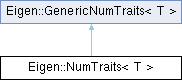
Inheritance diagram for Eigen::NumTraits< T >:
Additional Inherited Members | |
 Public Types inherited from Eigen::GenericNumTraits< T > Public Types inherited from Eigen::GenericNumTraits< T > | |
| enum | { IsInteger = std::numeric_limits<T>::is_integer , IsSigned = std::numeric_limits<T>::is_signed , IsComplex = 0 , RequireInitialization = internal::is_arithmetic<T>::value ? 0 : 1 , ReadCost = 1 , AddCost = 1 , MulCost = 1 } |
| typedef T | Real |
Detailed Description
template<typename T>
class Eigen::NumTraits< T >
class Eigen::NumTraits< T >
Holds information about the various numeric (i.e.
scalar) types allowed by Eigen.
- Template Parameters
-
T the numeric type at hand
This class stores enums, typedefs and static methods giving information about a numeric type.
The provided data consists of:
- A typedef
Real, giving the "real part" type of T. If T is already real, thenRealis just a typedef to T. If T isstd::complex<U>thenRealis a typedef to U. - A typedef
NonInteger, giving the type that should be used for operations producing non-integral values, such as quotients, square roots, etc. If T is a floating-point type, then this typedef just gives T again. Note however that many Eigen functions such asinternal::sqrtsimply refuse to take integers. Outside of a few cases, Eigen doesn't do automatic type promotion. Thus, this typedef is only intended as a helper for code that needs to explicitly promote types. - A typedef
Literalgiving the type to use for numeric literals such as "2" or "0.5". For instance, forstd::complex<U>, Literal is defined asU. Of course, this type must be fully compatible with T. In doubt, just use T here. - A typedef
Nestedgiving the type to use to nest a value inside of the expression tree. If you don't know what this means, just use T here. - An enum value
IsComplex. It is equal to 1 if T is astd::complextype, and to 0 otherwise. - An enum value
IsInteger. It is equal to1if T is an integer type such asint, and to0otherwise. - Enum values
ReadCost,AddCostandMulCostrepresenting a rough estimate of the number of CPU cycles needed to by move / add / mul instructions respectively, assuming the data is already stored in CPU registers. Stay vague here. No need to do architecture-specific stuff. If you don't know what this means, just useEigen::HugeCost. - An enum value
IsSigned. It is equal to1if T is a signed type and to 0 if T is unsigned. - An enum value
RequireInitialization. It is equal to1if the constructor of the numeric type T must be called, and to 0 if it is safe not to call it. Default is 0 if T is an arithmetic type, and 1 otherwise. - An
epsilon()function which, unlikestd::numeric_limits::epsilon(), it returns aRealinstead of a T. - A
dummy_precision()function returning a weak epsilon value. It is mainly used as a default value by the fuzzy comparison operators. highest()andlowest()functions returning the highest and lowest possible values respectively.digits()function returning the number of radix digits (non-sign digits for integers, mantissa for floating-point). This is the analogue of std::numeric_limits<T>::digits which is used as the default implementation if specialized.digits10()function returning the number of decimal digits that can be represented without change. This is the analogue of std::numeric_limits<T>::digits10 which is used as the default implementation if specialized.min_exponent()andmax_exponent()functions returning the highest and lowest possible values, respectively, such that the radix raised to the power exponent-1 is a normalized floating-point number. These are equivalent tostd::numeric_limits<T>::min_exponent/std::numeric_limits<T>::max_exponent.infinity()function returning a representation of positive infinity, if available.quiet_NaNfunction returning a non-signaling "not-a-number", if available.
The documentation for this class was generated from the following file:
- External/Eigen/src/Core/NumTraits.h