STL compatible allocator to use with types requiring a non standrad alignment. More...
#include <Memory.h>
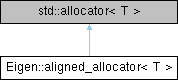
Inheritance diagram for Eigen::aligned_allocator< T >:
Data Structures | |
| struct | rebind |
Public Types | |
| typedef std::size_t | size_type |
| typedef std::ptrdiff_t | difference_type |
| typedef T * | pointer |
| typedef const T * | const_pointer |
| typedef T & | reference |
| typedef const T & | const_reference |
| typedef T | value_type |
Public Member Functions | |
| aligned_allocator (const aligned_allocator &other) | |
| template<class U > | |
| aligned_allocator (const aligned_allocator< U > &other) | |
| pointer | allocate (size_type num, const void *=0) |
| void | deallocate (pointer p, size_type) |
Detailed Description
template<class T>
class Eigen::aligned_allocator< T >
class Eigen::aligned_allocator< T >
STL compatible allocator to use with types requiring a non standrad alignment.
The memory is aligned as for dynamically aligned matrix/array types such as MatrixXd. By default, it will thus provide at least 16 bytes alignment and more in following cases:
- 32 bytes alignment if AVX is enabled.
- 64 bytes alignment if AVX512 is enabled.
This can be controlled using the EIGEN_MAX_ALIGN_BYTES macro as documented there .
Example:
// Matrix4f requires 16 bytes alignment:
std::map< int, Matrix4f, std::less<int>,
// Vector3f does not require 16 bytes alignment, no need to use Eigen's allocator:
std::map< int, Vector3f > my_map_vec3;
Base class for all dense matrices, vectors, and expressions.
Definition MatrixBase.h:50
- See also
- \blank TopicStlContainers.
The documentation for this class was generated from the following file:
- External/Eigen/src/Core/util/Memory.h