Sparse left-looking QR factorization with numerical column pivoting. More...
#include <SparseQR.h>
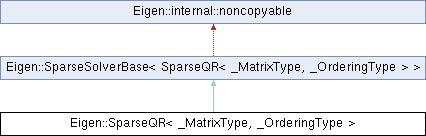
Public Types | |
| enum | { ColsAtCompileTime = MatrixType::ColsAtCompileTime , MaxColsAtCompileTime = MatrixType::MaxColsAtCompileTime } |
| typedef _MatrixType | MatrixType |
| typedef _OrderingType | OrderingType |
| typedef MatrixType::Scalar | Scalar |
| typedef MatrixType::RealScalar | RealScalar |
| typedef MatrixType::StorageIndex | StorageIndex |
| typedef SparseMatrix< Scalar, ColMajor, StorageIndex > | QRMatrixType |
| typedef Matrix< StorageIndex, Dynamic, 1 > | IndexVector |
| typedef Matrix< Scalar, Dynamic, 1 > | ScalarVector |
| typedef PermutationMatrix< Dynamic, Dynamic, StorageIndex > | PermutationType |
Public Member Functions | |
| SparseQR (const MatrixType &mat) | |
| Construct a QR factorization of the matrix mat. | |
| void | compute (const MatrixType &mat) |
| Computes the QR factorization of the sparse matrix mat. | |
| void | analyzePattern (const MatrixType &mat) |
| Preprocessing step of a QR factorization. | |
| void | factorize (const MatrixType &mat) |
| Performs the numerical QR factorization of the input matrix. | |
| Index | rows () const |
| Index | cols () const |
| const QRMatrixType & | matrixR () const |
| Index | rank () const |
| SparseQRMatrixQReturnType< SparseQR > | matrixQ () const |
| const PermutationType & | colsPermutation () const |
| std::string | lastErrorMessage () const |
| template<typename Rhs , typename Dest > | |
| bool | _solve_impl (const MatrixBase< Rhs > &B, MatrixBase< Dest > &dest) const |
| void | setPivotThreshold (const RealScalar &threshold) |
| Sets the threshold that is used to determine linearly dependent columns during the factorization. | |
| template<typename Rhs > | |
| const Solve< SparseQR, Rhs > | solve (const MatrixBase< Rhs > &B) const |
| template<typename Rhs > | |
| const Solve< SparseQR, Rhs > | solve (const SparseMatrixBase< Rhs > &B) const |
| ComputationInfo | info () const |
| Reports whether previous computation was successful. | |
| void | _sort_matrix_Q () |
 Public Member Functions inherited from Eigen::SparseSolverBase< SparseQR< _MatrixType, _OrderingType > > Public Member Functions inherited from Eigen::SparseSolverBase< SparseQR< _MatrixType, _OrderingType > > | |
| SparseSolverBase () | |
| Default constructor. | |
| SparseQR< _MatrixType, _OrderingType > & | derived () |
| const SparseQR< _MatrixType, _OrderingType > & | derived () const |
| const Solve< SparseQR< _MatrixType, _OrderingType >, Rhs > | solve (const MatrixBase< Rhs > &b) const |
| const Solve< SparseQR< _MatrixType, _OrderingType >, Rhs > | solve (const SparseMatrixBase< Rhs > &b) const |
| void | _solve_impl (const SparseMatrixBase< Rhs > &b, SparseMatrixBase< Dest > &dest) const |
Protected Types | |
| typedef SparseSolverBase< SparseQR< _MatrixType, _OrderingType > > | Base |
Protected Attributes | |
| bool | m_analysisIsok |
| bool | m_factorizationIsok |
| ComputationInfo | m_info |
| std::string | m_lastError |
| QRMatrixType | m_pmat |
| QRMatrixType | m_R |
| QRMatrixType | m_Q |
| ScalarVector | m_hcoeffs |
| PermutationType | m_perm_c |
| PermutationType | m_pivotperm |
| PermutationType | m_outputPerm_c |
| RealScalar | m_threshold |
| bool | m_useDefaultThreshold |
| Index | m_nonzeropivots |
| IndexVector | m_etree |
| IndexVector | m_firstRowElt |
| bool | m_isQSorted |
| bool | m_isEtreeOk |
| Protected Attributes inherited from Eigen::SparseSolverBase< SparseQR< _MatrixType, _OrderingType > > | |
| bool | m_isInitialized |
Friends | |
| template<typename , typename > | |
| struct | SparseQR_QProduct |
Detailed Description
class Eigen::SparseQR< _MatrixType, _OrderingType >
Sparse left-looking QR factorization with numerical column pivoting.
This class implements a left-looking QR decomposition of sparse matrices with numerical column pivoting. When a column has a norm less than a given tolerance it is implicitly permuted to the end. The QR factorization thus obtained is given by A*P = Q*R where R is upper triangular or trapezoidal.
P is the column permutation which is the product of the fill-reducing and the numerical permutations. Use colsPermutation() to get it.
Q is the orthogonal matrix represented as products of Householder reflectors. Use matrixQ() to get an expression and matrixQ().adjoint() to get the adjoint. You can then apply it to a vector.
R is the sparse triangular or trapezoidal matrix. The later occurs when A is rank-deficient. matrixR().topLeftCorner(rank(), rank()) always returns a triangular factor of full rank.
- Template Parameters
-
_MatrixType The type of the sparse matrix A, must be a column-major SparseMatrix<> _OrderingType The fill-reducing ordering method. See the OrderingMethods module for the list of built-in and external ordering methods.
\implsparsesolverconcept
The numerical pivoting strategy and default threshold are the same as in SuiteSparse QR, and detailed in the following paper: Tim Davis, "Algorithm 915, SuiteSparseQR: Multifrontal Multithreaded Rank-Revealing Sparse QR Factorization", ACM Trans. on Math. Soft. 38(1), 2011. Even though it is qualified as "rank-revealing", this strategy might fail for some rank deficient problems. When this class is used to solve linear or least-square problems it is thus strongly recommended to check the accuracy of the computed solution. If it failed, it usually helps to increase the threshold with setPivotThreshold.
- Warning
- The input sparse matrix A must be in compressed mode (see SparseMatrix::makeCompressed()).
- For complex matrices matrixQ().transpose() will actually return the adjoint matrix.
Constructor & Destructor Documentation
◆ SparseQR()
|
inlineexplicit |
Construct a QR factorization of the matrix mat.
- Warning
- The matrix mat must be in compressed mode (see SparseMatrix::makeCompressed()).
- See also
- compute()
Member Function Documentation
◆ analyzePattern()
| void Eigen::SparseQR< MatrixType, OrderingType >::analyzePattern | ( | const MatrixType & | mat | ) |
Preprocessing step of a QR factorization.
- Warning
- The matrix mat must be in compressed mode (see SparseMatrix::makeCompressed()).
In this step, the fill-reducing permutation is computed and applied to the columns of A and the column elimination tree is computed as well. Only the sparsity pattern of mat is exploited.
- Note
- In this step it is assumed that there is no empty row in the matrix mat.
◆ cols()
|
inline |
- Returns
- the number of columns of the represented matrix.
◆ colsPermutation()
|
inline |
- Returns
- a const reference to the column permutation P that was applied to A such that A*P = Q*R It is the combination of the fill-in reducing permutation and numerical column pivoting.
◆ compute()
|
inline |
Computes the QR factorization of the sparse matrix mat.
- Warning
- The matrix mat must be in compressed mode (see SparseMatrix::makeCompressed()).
- See also
- analyzePattern(), factorize()
◆ factorize()
| void Eigen::SparseQR< MatrixType, OrderingType >::factorize | ( | const MatrixType & | mat | ) |
Performs the numerical QR factorization of the input matrix.
The function SparseQR::analyzePattern(const MatrixType&) must have been called beforehand with a matrix having the same sparsity pattern than mat.
- Parameters
-
mat The sparse column-major matrix
◆ info()
|
inline |
Reports whether previous computation was successful.
- Returns
Successif computation was successful,NumericalIssueif the QR factorization reports a numerical problemInvalidInputif the input matrix is invalid
- See also
- iparm()
◆ lastErrorMessage()
|
inline |
- Returns
- A string describing the type of error. This method is provided to ease debugging, not to handle errors.
◆ matrixQ()
|
inline |
- Returns
- an expression of the matrix Q as products of sparse Householder reflectors. The common usage of this function is to apply it to a dense matrix or vector
To get a plain SparseMatrix representation of Q:
Internally, this call simply performs a sparse product between the matrix Q and a sparse identity matrix. However, due to the fact that the sparse reflectors are stored unsorted, two transpositions are needed to sort them before performing the product.
◆ matrixR()
|
inline |
- Returns
- a const reference to the sparse upper triangular matrix R of the QR factorization.
- Warning
- The entries of the returned matrix are not sorted. This means that using it in algorithms expecting sorted entries will fail. This include random coefficient accesses (SpaseMatrix::coeff()), and coefficient-wise operations. Matrix products and triangular solves are fine though.
To sort the entries, you can assign it to a row-major matrix, and if a column-major matrix is required, you can copy it again:
◆ rank()
|
inline |
- Returns
- the number of non linearly dependent columns as determined by the pivoting threshold.
- See also
- setPivotThreshold()
◆ rows()
|
inline |
- Returns
- the number of rows of the represented matrix.
◆ setPivotThreshold()
|
inline |
Sets the threshold that is used to determine linearly dependent columns during the factorization.
In practice, if during the factorization the norm of the column that has to be eliminated is below this threshold, then the entire column is treated as zero, and it is moved at the end.
◆ solve()
|
inline |
- Returns
- the solution X of


- See also
- compute()
The documentation for this class was generated from the following file:
- External/Eigen/src/SparseQR/SparseQR.h