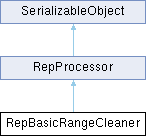
Inheritance diagram for RepBasicRangeCleaner:
Public Member Functions | |
| RepBasicRangeCleaner () | |
| default constructor | |
| void | init_tables (MedDictionarySections &dict, MedSignals &sigs) |
| initialize signal ids | |
| void | register_virtual_section_name_id (MedDictionarySections &dict) |
| Register section id to section name of new virtual signals. | |
| bool | get_last_n_value (int time, const UniversalSigVec &range_sig, float &last_value) |
| virtual int | init (map< string, string > &mapper) |
| Fill required- and affected-signals sets. | |
| int | _apply (PidDynamicRec &rec, vector< int > &time_points, vector< vector< float > > &attributes_mat) |
| Apply cleaning model. | |
| void | fit_for_repository (MedPidRepository &rep) |
| make changes to RepProcessor according to available signals in Repository | |
| ADD_SERIALIZATION_FUNCS (processor_type, signal_name, ranges_name, output_name, time_channel, req_signals, aff_signals, signal_id, ranges_id, output_id, virtual_signals, virtual_signals_generic, output_type, get_values_in_range, range_operator, range_val_channel, sets, range_time_channel, last_n, do_on_last_n, regex_on_sets) void print() | |
| Serialization. | |
 Public Member Functions inherited from RepProcessor Public Member Functions inherited from RepProcessor | |
| virtual void | clear () |
| virtual int | init (void *params) |
| initialize from a params object : Should be implemented for inheriting classes that have parameters | |
| virtual void | init_defaults () |
| initialize to default values : Should be implemented for inheriting classes that have parameters | |
| virtual void | set_signal (const string &_signalName) |
| set signal-name : Should be implemented for inheriting classes that have signalName | |
| virtual void | set_signal_ids (MedSignals &sigs) |
| set signal-ids : Should be implemented for inheriting classes that have signalId | |
| virtual void | get_required_signal_names (unordered_set< string > &signalNames) |
| Append required signal names to set : parent function just uses req_signals. | |
| virtual void | get_required_signal_names (unordered_set< string > &signalNames, unordered_set< string > preReqSignals) |
| Append required signal names to set only if processor is actually required to produce any of preReqSignals : parent function just uses req_signals. | |
| virtual void | set_required_signal_ids (MedDictionarySections &dict) |
| Fill req_signal_ids : parent function just fills from req_signals. | |
| virtual void | add_virtual_signals (map< string, int > &_virtual_signals, map< string, string > &_virtual_signals_generic) const |
| rep processors CREATING virtual signals need to implement this: adding their signals to the pile | |
| virtual void | get_required_signal_ids (unordered_set< int > &signalIds) |
| Append required signal names to set : parent function just uses req_signals. | |
| virtual void | get_required_signal_ids (unordered_set< int > &signalIds, unordered_set< int > preReqSignals) |
| Append required signal names to set only if processor is actually required to produce any of preReqSignals : parent function just uses req_signals. | |
| virtual void | set_affected_signal_ids (MedDictionarySections &dict) |
| Fill aff_signal_ids : parent function just fills from aff_signals. | |
| bool | is_signal_affected (int signalId) |
Check if a signal is affected by processor </summray>
| |
| bool | is_signal_affected (string &signalName) |
| virtual bool | filter (unordered_set< string > &reqSignals) |
Check if processor (and 'sub'-processors within) should be applied according to set of required signals </summray>
| |
| virtual void | init_attributes () |
| Init attributes information : Should be implemented for inheriting classes that have attributes. | |
| virtual int | _learn (MedPidRepository &rep, MedSamples &samples, vector< RepProcessor * > &prev_processors) |
| learn processing model on a subset of samples. Apply set of preceeding processors on DynamicPidRec before learning : | |
| virtual int | _conditional_learn (MedPidRepository &rep, MedSamples &samples, vector< RepProcessor * > &prev_processors, unordered_set< int > &neededSignalIds) |
| learn processing model on a subset of samples only if required. Apply set of preceeding processors on DynamicPidRec before learning : | |
| int | learn (MedPidRepository &rep, MedSamples &samples, vector< RepProcessor * > &prev_processors) |
| learn processing model on a subset of ids. Apply set of preceeding processors on DynamicPidRec before learning | |
| int | learn (MedPidRepository &rep) |
| learn on all pids in repository, using fake samples - works only for repProcessors that ignore sample dates | |
| int | learn (MedPidRepository &rep, MedSamples &samples) |
| learn on subset of samples without preceesing processors | |
| virtual int | conditional_learn (MedPidRepository &rep, MedSamples &samples, vector< RepProcessor * > &prev_processors, unordered_set< int > &neededSignalIds) |
| learn processing model on a subset of samples only if required. Apply set of preceeding processors on DynamicPidRec before learning : | |
| int | conditional_learn (MedPidRepository &rep, MedSamples &samples, unordered_set< int > &neededSignalIds) |
| learn processing model on a subset of ids only if required without preceesing processors | |
| virtual int | _conditional_apply (PidDynamicRec &rec, vector< int > &time_points, unordered_set< int > &neededSignalIds, vector< vector< float > > &attributes_vals) |
| apply processing on a single PidDynamicRec at a set of time-points only if required : May be implemented for inheriting classes | |
| virtual int | _apply_simple (PidDynamicRec &rec, vector< int > &time_points) |
| int | apply (PidDynamicRec &rec, vector< int > &time_points, vector< vector< float > > &attributes_vals) |
| apply processing on a single PidDynamicRec at a set of time-points | |
| int | conditional_apply (PidDynamicRec &rec, vector< int > &time_points, unordered_set< int > &neededSignalIds, vector< vector< float > > &attributes_vals) |
| apply processing on a single PidDynamicRec at a set of time-points only if required : if any of the signals in neededSignalIds is actually affected by processor | |
| int | apply (PidDynamicRec &rec, MedIdSamples &samples) |
| apply processing on a single PidDynamicRec at a set of time-points given by samples | |
| int | conditional_apply (PidDynamicRec &rec, MedIdSamples &samples, unordered_set< int > &neededSignalIds) |
| apply processing on a single PidDynamicRec at a set of time-points given by samples only if required | |
| int | conditional_apply_without_attributes (PidDynamicRec &rec, const MedIdSamples &samples, unordered_set< int > &neededSignalIds) |
| apply processing on a single PidDynamicRec at a set of time-points given by samples only if required, not affecting attributes | |
| virtual void | dprint (const string &pref, int rp_flag) |
| used for debug prints, each inheriting class can overload this one to get a more precise debug print. | |
| virtual void | make_summary () |
| virtual void | get_required_signal_categories (unordered_map< string, vector< string > > &signal_categories_in_use) const |
| returns for each used signal it's used categories | |
| void * | new_polymorphic (string derived_class_name) |
| for polymorphic classes that want to be able to serialize/deserialize a pointer * to the derived class given its type one needs to implement this function to return a new to the derived class given its type (as in my_type) | |
| size_t | get_processor_size () |
| get size of processor + processor_type | |
| size_t | processor_serialize (unsigned char *blob) |
| seialize processor + processor_type | |
| virtual void | print () |
| optional printing of processor | |
| Public Member Functions inherited from SerializableObject | |
| virtual int | version () const |
| Relevant for serializations. | |
| virtual string | my_class_name () const |
| For better handling of serializations it is highly recommended that each SerializableObject inheriting class will implement the next method. | |
| virtual void | serialized_fields_name (vector< string > &field_names) const |
| The names of the serialized fields. | |
| virtual void | pre_serialization () |
| virtual void | post_deserialization () |
| virtual size_t | get_size () |
| Gets bytes sizes for serializations. | |
| virtual size_t | serialize (unsigned char *blob) |
| Serialiazing object to blob memory. return number ob bytes wrote to memory. | |
| virtual size_t | deserialize (unsigned char *blob) |
| Deserialiazing blob to object. returns number of bytes read. | |
| size_t | serialize_vec (vector< unsigned char > &blob) |
| size_t | deserialize_vec (vector< unsigned char > &blob) |
| virtual size_t | serialize (vector< unsigned char > &blob) |
| virtual size_t | deserialize (vector< unsigned char > &blob) |
| virtual int | read_from_file (const string &fname) |
| read and deserialize model | |
| virtual int | write_to_file (const string &fname) |
| serialize model and write to file | |
| virtual int | read_from_file_unsafe (const string &fname) |
| read and deserialize model without checking version number - unsafe read | |
| int | init_from_string (string init_string) |
| Init from string. | |
| int | init_params_from_file (string init_file) |
| int | init_param_from_file (string file_str, string ¶m) |
| int | update_from_string (const string &init_string) |
| virtual int | update (map< string, string > &map) |
| Virtual to update object from parsed fields. | |
| virtual string | object_json () const |
Data Fields | |
| string | signal_name |
| name of signal to clean | |
| string | ranges_name |
| name of signal that defines ranges | |
| string | output_name |
| name of output virtual signal - defaults to signal_name + "_" + ranges_name | |
| int | signal_id |
| id of signal to clean | |
| int | ranges_id |
| id of signal the defines ranges | |
| int | output_id |
| id of output signal | |
| int | time_channel |
| time channel to consider in cleaning in the original signal | |
| int | range_time_channel |
| range time channel to consider in cleaning. this time channel will be used to check we're not using the future in the range signal | |
| int | output_type |
| output signal type - should be identical to input signal type default to range + val type. Or string for generic type | |
| int | get_values_in_range = 1 |
| if 1 (default) : keep only records time in range, if 0 : stay with the values out of range | |
| range_op_type | range_operator = range_op_type::all |
| options are all(default), first, last - which range to use in the reference signal | |
| int | range_val_channel = -1 |
| the val channel in range signal to filter range signal. If < 0 or empty sets will not filter | |
| vector< string > | sets |
| sets use to filter ranges_name signal on range_val_channel. If empty or range_val_channel, no filters | |
| bool | regex_on_sets = 0 |
| Whether to use aggregation of .*sets[i].* regex to create new sets vector (override original sets) | |
| int | last_n = 0 |
| instead of looking on sets, take last value from range. 0 means current state, 1 one before, etc.j | |
| bool | do_on_last_n = false |
| if true, will use only last nth (using time channel 0) range signal backward from sample time and use this value to filter range. uses last_n value | |
| Data Fields inherited from RepProcessor | |
| RepProcessorTypes | processor_type = REP_PROCESS_LAST |
| type of repository processor | |
| unordered_set< string > | req_signals |
| names of signals required for processsing | |
| unordered_set< int > | req_signal_ids |
| ids of signals required for processing | |
| unordered_set< string > | aff_signals |
| names of signals affected by processing | |
| unordered_set< int > | aff_signal_ids |
| ids of signals affected by processing | |
| bool | unconditional = false |
| indicated that processor should ALWAYS be applied | |
| vector< string > | attributes |
| attributes generated by the processor (optional) | |
| vector< pair< string, int > > | virtual_signals |
| virtual signals are created only in rep processors but can be used by any rep processor that comes after or any feture generator as a regular signal. | |
| vector< pair< string, string > > | virtual_signals_generic |
Additional Inherited Members | |
| Static Public Member Functions inherited from RepProcessor | |
| static RepProcessor * | make_processor (string name) |
| create a new repository processor from name | |
| static RepProcessor * | make_processor (string type, string params) |
| create a new repository processor from name and a parameters string | |
| static RepProcessor * | make_processor (RepProcessorTypes type) |
| create a new repository processor from type | |
| static RepProcessor * | make_processor (RepProcessorTypes type, string params) |
| create a new repository processor from type and a parameters string | |
| static RepProcessor * | create_processor (string ¶ms) |
| create a new repository processor from parameters string which contains rp_type | |
Member Function Documentation
◆ _apply()
|
virtual |
Apply cleaning model.
Reimplemented from RepProcessor.
◆ ADD_SERIALIZATION_FUNCS()
| RepBasicRangeCleaner::ADD_SERIALIZATION_FUNCS | ( | processor_type | , |
| signal_name | , | ||
| ranges_name | , | ||
| output_name | , | ||
| time_channel | , | ||
| req_signals | , | ||
| aff_signals | , | ||
| signal_id | , | ||
| ranges_id | , | ||
| output_id | , | ||
| virtual_signals | , | ||
| virtual_signals_generic | , | ||
| output_type | , | ||
| get_values_in_range | , | ||
| range_operator | , | ||
| range_val_channel | , | ||
| sets | , | ||
| range_time_channel | , | ||
| last_n | , | ||
| do_on_last_n | , | ||
| regex_on_sets | |||
| ) |
Serialization.
Print processors information
◆ fit_for_repository()
|
virtual |
make changes to RepProcessor according to available signals in Repository
Reimplemented from RepProcessor.
◆ init()
|
virtual |
Fill required- and affected-signals sets.
The parsed fields from init command.
if (field == "signal_name")
{
signal_name = entry.second;
}
else if (field == "rp_type")
{
}
else if (field == "ranges_sig_name")
{
ranges_name = entry.second;
}
else if (field == "output_name")
{
output_name = entry.second;
}
else if (field == "time_channel")
time_channel = med_stoi(entry.second);
else if (field == "range_time_channel")
range_time_channel = med_stoi(entry.second);
else if (field == "get_values_in_range")
get_values_in_range = med_stoi(entry.second);
else if (field == "range_operator")
range_operator = get_range_op(entry.second);
else if (field == "range_val_channel")
range_val_channel = med_stoi(entry.second);
else if (field == "regex_on_sets")
regex_on_sets = (bool)med_stoi(entry.second);
else if (field == "last_n")
{
last_n = med_stoi(entry.second);
do_on_last_n = true;
}
else if (field == "sets")
{
boost::split(sets, entry.second, boost::is_any_of(",;"));
}
else if (field == "output_type")
{
if (_is_numeric(entry.second))
output_type = med_stoi(entry.second);
else
output_type_s = entry.second;
} // needs to match the input signal type! defaults to range-value signal (3)
else
MTHROW_AND_ERR("Error in RepBasicRangeCleaner::init - Unsupported param \"%s\"\n", field.c_str());
string signal_name
name of signal to clean
Definition RepProcess.h:1566
string output_name
name of output virtual signal - defaults to signal_name + "_" + ranges_name
Definition RepProcess.h:1568
int time_channel
time channel to consider in cleaning in the original signal
Definition RepProcess.h:1572
string ranges_name
name of signal that defines ranges
Definition RepProcess.h:1567
vector< string > sets
sets use to filter ranges_name signal on range_val_channel. If empty or range_val_channel,...
Definition RepProcess.h:1578
int range_val_channel
the val channel in range signal to filter range signal. If < 0 or empty sets will not filter
Definition RepProcess.h:1577
bool do_on_last_n
if true, will use only last nth (using time channel 0) range signal backward from sample time and use...
Definition RepProcess.h:1581
int get_values_in_range
if 1 (default) : keep only records time in range, if 0 : stay with the values out of range
Definition RepProcess.h:1575
int range_time_channel
range time channel to consider in cleaning. this time channel will be used to check we're not using t...
Definition RepProcess.h:1573
range_op_type range_operator
options are all(default), first, last - which range to use in the reference signal
Definition RepProcess.h:1576
int last_n
instead of looking on sets, take last value from range. 0 means current state, 1 one before,...
Definition RepProcess.h:1580
bool regex_on_sets
Whether to use aggregation of .*sets[i].* regex to create new sets vector (override original sets)
Definition RepProcess.h:1579
int output_type
output signal type - should be identical to input signal type default to range + val type....
Definition RepProcess.h:1574
Reimplemented from RepProcessor.
◆ init_tables()
|
virtual |
initialize signal ids
Reimplemented from RepProcessor.
◆ register_virtual_section_name_id()
|
virtual |
Register section id to section name of new virtual signals.
Reimplemented from RepProcessor.
The documentation for this class was generated from the following files:
- Internal/MedProcessTools/MedProcessTools/RepProcess.h
- Internal/MedProcessTools/MedProcessTools/RepProcess.cpp