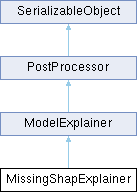
Shapely Explainer - Based on learning training data to handle missing_values as "correct" input. More...
#include <ExplainWrapper.h>
Public Member Functions | |
| void | _learn (const MedFeatures &train_mat) |
| overload function for ModelExplainer - easier API | |
| void | explain (const MedFeatures &matrix, vector< map< string, float > > &sample_explain_reasons) const |
| Virtual - return explain results in sample_feature_contrib. | |
 Public Member Functions inherited from ModelExplainer Public Member Functions inherited from ModelExplainer | |
| virtual int | init (map< string, string > &mapper) |
| Global init for general args in all explainers. initialize directly all args in GlobalExplainerParams. | |
| virtual int | update (map< string, string > &mapper) |
| Virtual to update object from parsed fields. | |
| virtual void | Learn (const MedFeatures &train_mat) |
| Learns from predictor and train_matrix (PostProcessor API) | |
| void | Apply (MedFeatures &matrix) |
| alias for explain | |
| void | get_input_fields (vector< Effected_Field > &fields) const |
| List of fields that are used by this post_processor. | |
| void | get_output_fields (vector< Effected_Field > &fields) const |
| List of fields that are being effected by this post_processor. | |
| void | init_post_processor (MedModel &model) |
| Init ModelExplainer from MedModel - copies predictor pointer, might save normalizers pointers. | |
| virtual void | explain (MedFeatures &matrix) const |
| Stores explain results in matrix. | |
| void | dprint (const string &pref) const |
| Public Member Functions inherited from PostProcessor | |
| void * | new_polymorphic (string dname) |
| for polymorphic classes that want to be able to serialize/deserialize a pointer * to the derived class given its type one needs to implement this function to return a new to the derived class given its type (as in my_type) | |
| virtual float | get_use_p () |
| virtual int | get_use_split () |
| Public Member Functions inherited from SerializableObject | |
| virtual int | version () const |
| Relevant for serializations. | |
| virtual string | my_class_name () const |
| For better handling of serializations it is highly recommended that each SerializableObject inheriting class will implement the next method. | |
| virtual void | serialized_fields_name (vector< string > &field_names) const |
| The names of the serialized fields. | |
| virtual void | pre_serialization () |
| virtual void | post_deserialization () |
| virtual size_t | get_size () |
| Gets bytes sizes for serializations. | |
| virtual size_t | serialize (unsigned char *blob) |
| Serialiazing object to blob memory. return number ob bytes wrote to memory. | |
| virtual size_t | deserialize (unsigned char *blob) |
| Deserialiazing blob to object. returns number of bytes read. | |
| size_t | serialize_vec (vector< unsigned char > &blob) |
| size_t | deserialize_vec (vector< unsigned char > &blob) |
| virtual size_t | serialize (vector< unsigned char > &blob) |
| virtual size_t | deserialize (vector< unsigned char > &blob) |
| virtual int | read_from_file (const string &fname) |
| read and deserialize model | |
| virtual int | write_to_file (const string &fname) |
| serialize model and write to file | |
| virtual int | read_from_file_unsafe (const string &fname) |
| read and deserialize model without checking version number - unsafe read | |
| int | init_from_string (string init_string) |
| Init from string. | |
| int | init_params_from_file (string init_file) |
| int | init_param_from_file (string file_str, string ¶m) |
| int | update_from_string (const string &init_string) |
| virtual string | object_json () const |
Data Fields | |
| int | add_new_data |
| how many new data data points to add for train according to sample masks | |
| bool | no_relearn |
| If true will use original model without relearn. assume original model is good enough for missing vals (for example LM model) | |
| int | max_test |
| max number of samples in SHAP | |
| float | missing_value |
| missing value | |
| bool | sample_masks_with_repeats |
| Whether or not to sample masks with repeats. | |
| float | select_from_all |
| If max_test is beyond this percentage of all options than sample from all options (to speed up runtime) | |
| bool | uniform_rand |
| it True will sample masks uniformlly | |
| bool | use_shuffle |
| if not sampling uniformlly, If true will use shuffle (to speed up runtime) | |
| string | predictor_args |
| arguments to change in predictor - for example to change it into regression | |
| string | predictor_type |
| bool | verbose_learn |
| If true will print more in learn. | |
| string | verbose_apply |
| If has value - output file. | |
| float | max_weight |
| the maximal weight number. if < 0 no limit | |
| int | subsample_train |
| if not zero will use this to subsample original train sampels to this number | |
| int | limit_mask_size |
| if set will limit mask size in the train - usefull for minimal_set | |
| bool | use_minimal_set |
| If true will use different method to find minimal set. | |
| float | sort_params_a |
| weight for minimal distance from original score importance | |
| float | sort_params_b |
| weight for variance in prediction using imputation. the rest is change from prev | |
| float | sort_params_k1 |
| weight for minimal distance from original score importance | |
| float | sort_params_k2 |
| weight for variance in prediction using imputation. the rest is change from prev | |
| int | max_set_size |
| the size to look for to explain | |
| float | override_score_bias |
| when given will use it as score bias it train is very different from test | |
| float | split_to_test |
| to report RMSE on this ratio > 0 and < 1 | |
| Data Fields inherited from ModelExplainer | |
| MedPredictor * | original_predictor = NULL |
| predictor we're trying to explain | |
| ExplainFilters | filters |
| general filters of results | |
| ExplainProcessings | processing |
| processing of results, like groupings, COV | |
| GlobalExplainerParams | global_explain_params |
| Data Fields inherited from PostProcessor | |
| PostProcessorTypes | processor_type = PostProcessorTypes::FTR_POSTPROCESS_LAST |
| int | use_split = -1 |
| float | use_p = 0.0 |
Additional Inherited Members | |
| Static Public Member Functions inherited from ModelExplainer | |
| static void | print_explain (MedSample &smp, int sort_mode=0) |
| Static Public Member Functions inherited from PostProcessor | |
| static PostProcessor * | make_processor (const string &processor_name, const string ¶ms="") |
| static PostProcessor * | make_processor (PostProcessorTypes type, const string ¶ms="") |
| static PostProcessor * | create_processor (string ¶ms) |
Detailed Description
Shapely Explainer - Based on learning training data to handle missing_values as "correct" input.
so predicting on missing_values mask would give E[F(X)], whwn X has missing values, will allow much faster compution. All we need to do is reweight or manipulate missing_values(erase/add missing values) that each sample would look like: First we sample uniformally how many missing values should be - than randomally remove those value and set them as missing values. This will cause the weight of each count of missing values to be equal in train - same as weights in SHAP values calculation
Member Function Documentation
◆ _learn()
|
virtual |
overload function for ModelExplainer - easier API
Implements ModelExplainer.
◆ explain()
|
virtual |
Virtual - return explain results in sample_feature_contrib.
Implements ModelExplainer.
The documentation for this class was generated from the following files:
- Internal/MedProcessTools/MedProcessTools/ExplainWrapper.h
- Internal/MedProcessTools/MedProcessTools/ExplainWrapper.cpp